
The cathedral and the zócalo, the town's front room
An ochre facade picked out in red and white, a bandstand under the trees and an arcaded palace: the main square is where San Cristóbal gathers, argues, celebrates and rests.
- From the zócalo
- You are already there
- Altitude
- In town
- Getting there
- The centre of the old town
- Bring
- A warm layer for the evening
 Shot by BIOLOGO JORGE AYALA · licence CC BY-SA (source file)

Every walk in San Cristóbal seems to pass through the zócalo sooner or later. Officially it carries a formal civic name, but almost everyone just calls it the zócalo or the parque central, and it works as the town's front room: a place to sit, to meet, to wait for someone, to watch a procession or simply to warm up in the midday sun after a cold morning.
The square sits where the Spanish laid out the town in the 1520s, when they founded a settlement in the valley the Tzotzil know as Jovel. The town has changed its name several times since. Its present name honours, in part, Bartolomé de las Casas, the sixteenth-century Dominican bishop of Chiapas remembered for defending the rights of indigenous people. For a long period San Cristóbal was also the capital of Chiapas, before the government moved to Tuxtla Gutiérrez in the lowlands, and the buildings around the square still carry something of that official past.
The cathedral facade
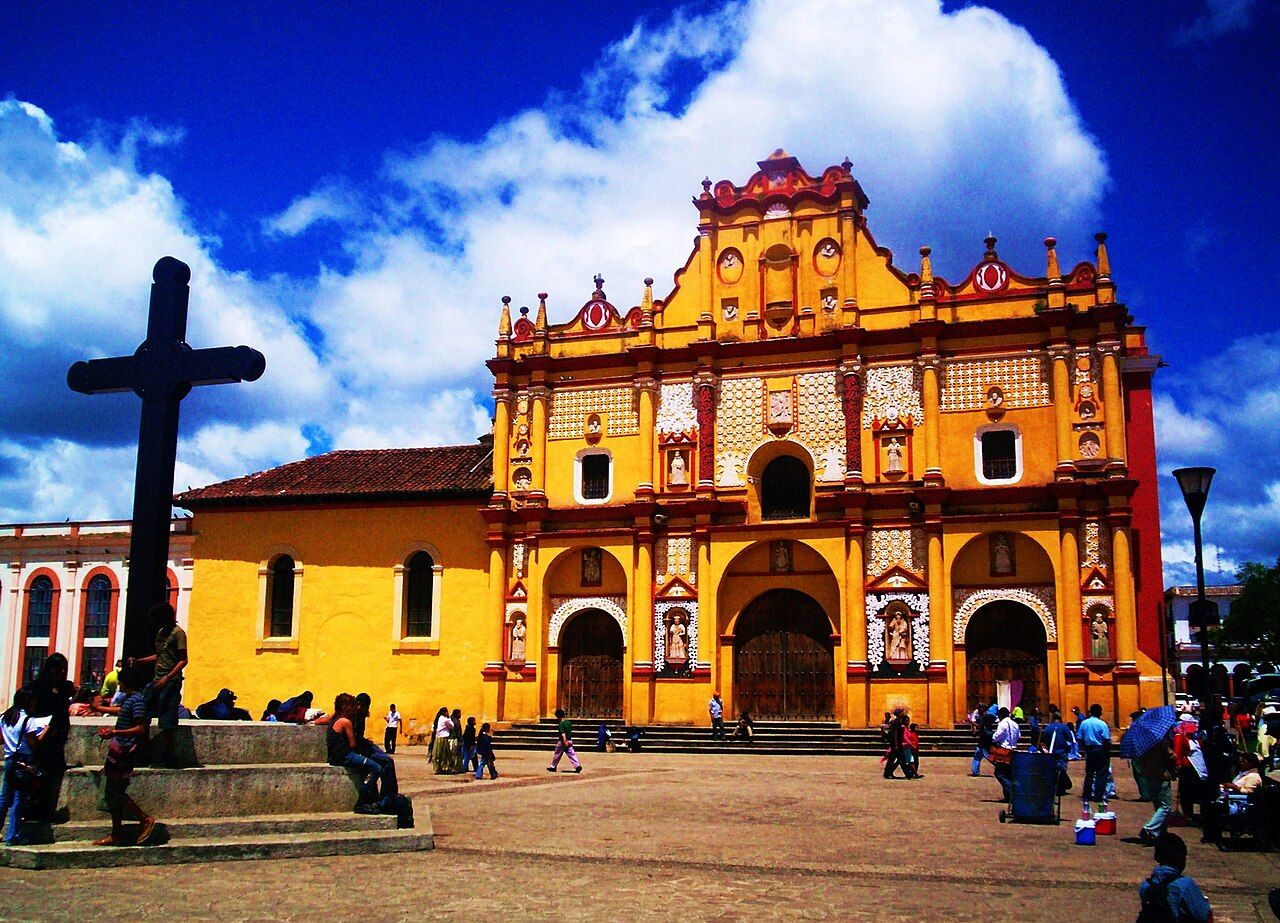
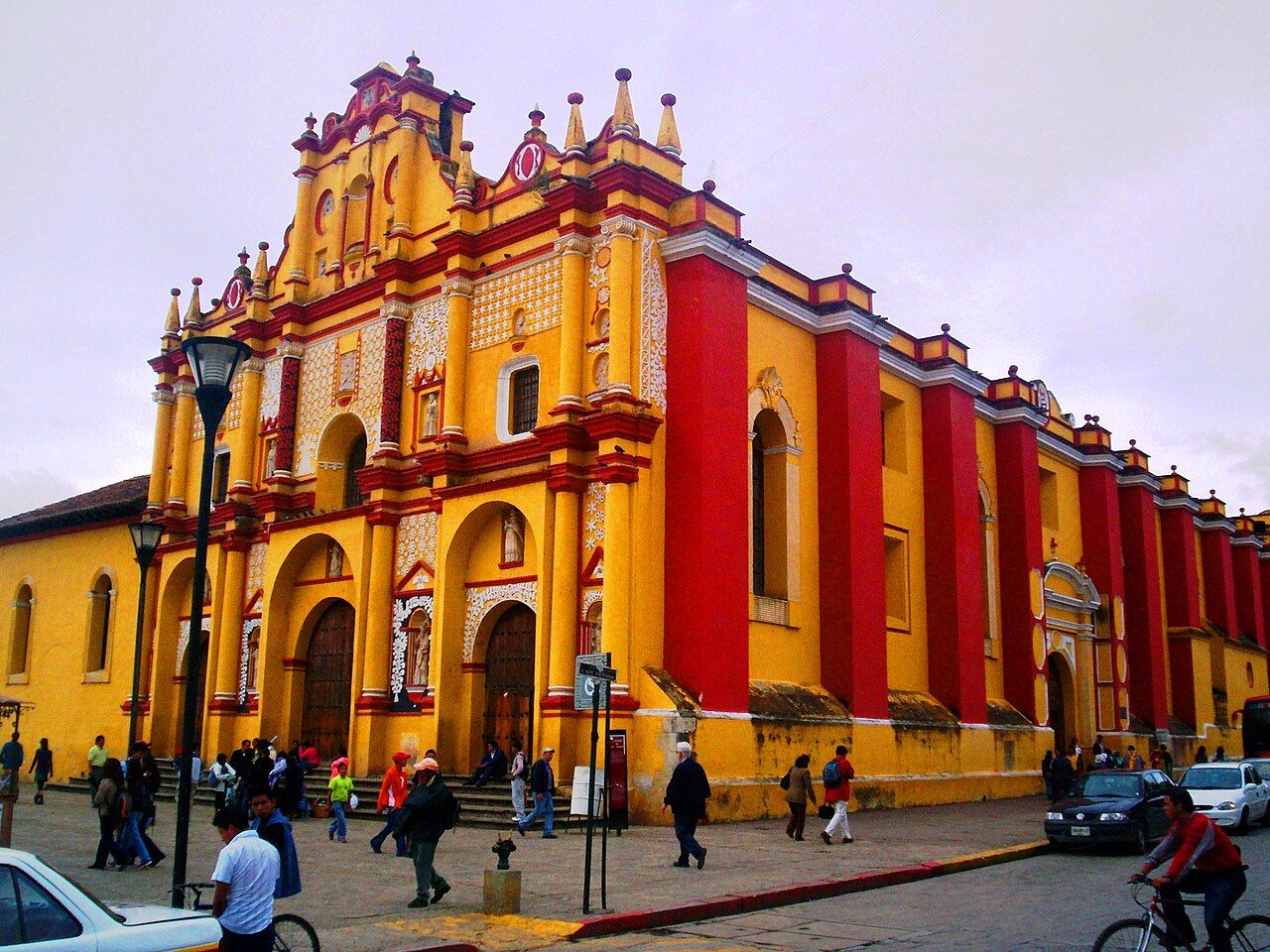
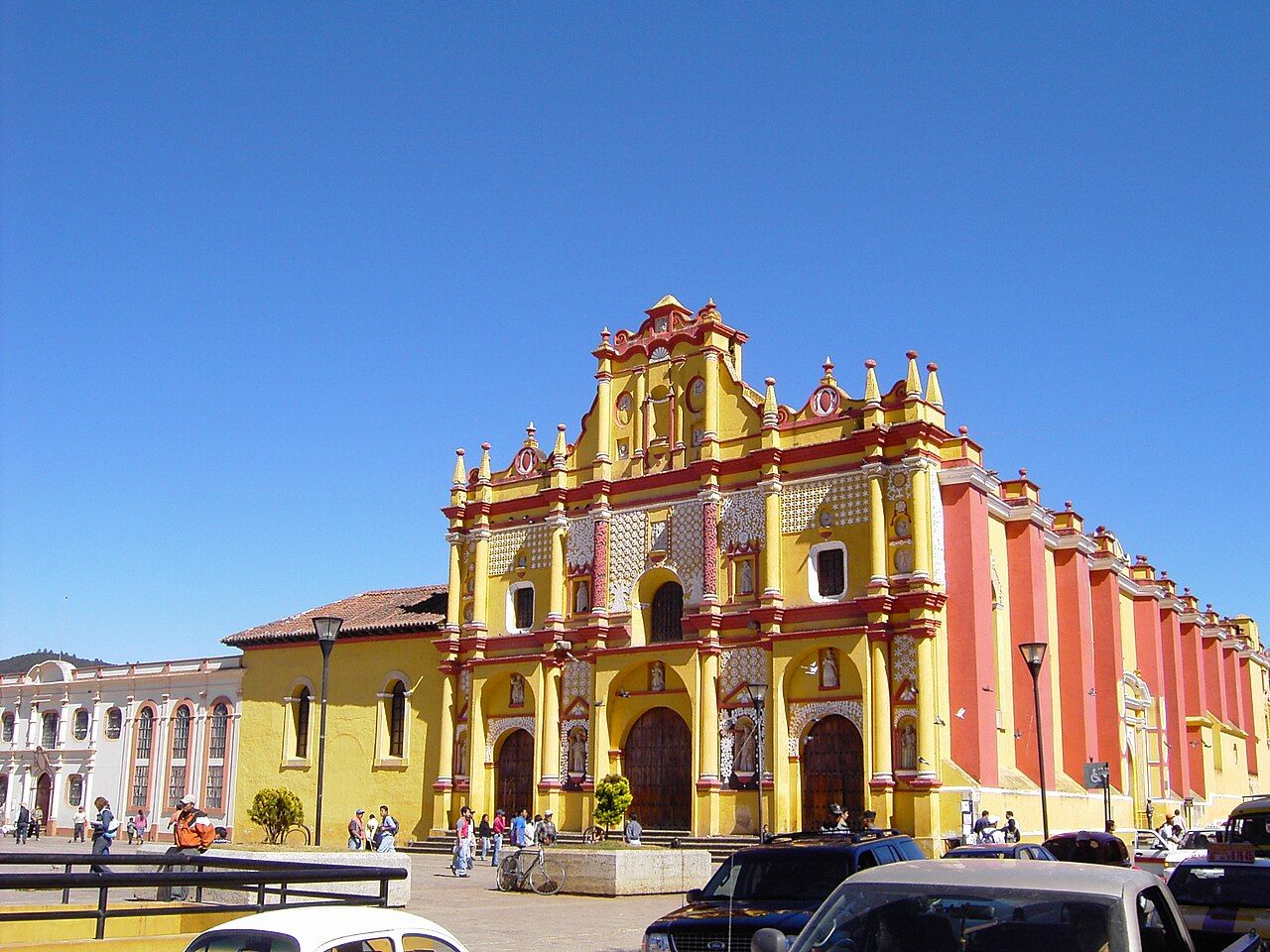
The cathedral stands on the north side of the zócalo, with its main facade facing west onto its own smaller plaza. It is the colour that people remember: a deep ochre yellow, with columns, cornices and window frames picked out in brick red and panels of white plasterwork worked into flowers and geometric patterns. Niches hold carved saints, and the top of the facade steps up in a series of curved and pointed crests.
 Shot by BIOLOGO JORGE AYALA · licence CC BY-SA (source file)

The building has been rebuilt, extended and repaired many times since the first church went up in the sixteenth century. Earthquakes have damaged it more than once, and the long side wall, with its tall red pilasters marching along the street, shows how big the structure really is. Restoration work comes and goes; parts of the building may be covered in scaffolding or closed when you visit.
Inside, the cathedral is an active parish church rather than a museum. Gilded altarpieces and old paintings line the walls, but people come here to pray, light candles and attend Mass. Cover shoulders, speak softly, and stay put while a service is under way. If photography is permitted when you visit, leave the flash off and keep the camera away from people at prayer.
The plaza in front of the cathedral
West of the main facade lies a smaller open square, often busy with people sitting on the steps, children chasing pigeons and vendors walking between groups of visitors. A large wooden cross stands at one side, a simple counterpoint to the elaborate facade behind it.
This is the best place to look at the cathedral as a whole. Come in the late afternoon, when the sun drops low in the west and lights the yellow and red directly, and the colours glow against the mountains behind. In the rainy season, clouds often build over the hills by early afternoon, so morning can be the better bet for a blue sky.
The kiosk and the gardens
The zócalo itself is a shaded garden laid out with paths, benches and trees, with a raised kiosk at its centre. The kiosk is a bandstand of the kind found in many Mexican towns, and on some evenings and holidays music is played there or nearby. Benches around it fill with families, couples and older residents reading the paper or chatting in the shade.
Shoe shiners work along the paths, and sellers of balloons, snacks, newspapers and handicrafts circulate all day. Many of the women and children selling textiles and bracelets come in from the highland villages around the valley; a polite refusal is always acceptable, and a purchase made without heavy haggling is a fair way to say yes.
Also in the valley: The andadores: walking the car-free streets of San Cristóbal
The municipal palace and the arcades
On the west side of the zócalo stands the Palacio Municipal, a long neoclassical building with an arcade of columns along the front. It houses the town government, and its covered walkway gives you somewhere to shelter when one of the valley's sudden downpours sweeps across the square. Other sides of the plaza are lined with arcades and colonial buildings, many now used for businesses on the ground floor.
The palace has a place in recent history as well. On the first of January 1994, the Zapatista movement briefly occupied it and several other town halls in Chiapas, an event that drew world attention to the region's indigenous communities. The story is told more fully, and with care, in the guide to Tzotzil, Tzeltal and being a guest. Today the building is simply the seat of local government, and protests or civic gatherings still take place in front of it from time to time.
 Shot by Odysseus79 · Public Domain source file

Sunday evenings and feast days
The zócalo is at its best in the evening, and particularly on Sundays and holidays. Families walk slowly around the gardens, children run between the benches, and the streets that lead off the square fill with people heading to and from the walking streets. The light fades quickly at this altitude, and once it does the air turns cold: bring a jacket even if the afternoon was warm.
Religious feasts and civic holidays bring processions, fireworks, music and decorations to the square. Mexico's Independence celebrations in mid-September and the Christmas season are among the busiest times, and the town's own festivals, covered in the story on candles and feast days, also pass through.
Making the most of the square
The zócalo is the natural starting point for walking the rest of the old town. From here, Real de Guadalupe heads east towards the hill of Guadalupe, the andador runs south to the Arco del Carmen, and the route north passes the cathedral on its way to Santo Domingo and the textile market. All of them are flat, short and easy to combine in a morning.
Sit for a while before you move on. Watching the square fill and empty over an hour or two tells you more about the rhythm of San Cristóbal than any building can. As anywhere busy, keep an eye on your bag in the evening crowds, and keep in mind that public events, closures and restoration work change the look of the square from one season to the next.
Camera work: Rod Waddington · licence CC BY-SA (source file); Linkogecko · licence CC BY-SA (source file); Anthony G. Reyes · licence CC BY-SA (source file)


